
Platform
 Overview
 Integrations
Use Cases
Many Possibilities. One Platform.
 Marketing Changes
 Cross - Platform
 Everything
 Budget Allocation
AI and Automation
The Always-on Incrementality Platform
 Explorer
 Analyst
 Geolift
 Actionable Insights
 Media Mix Modeling
Solutions
Teams
Built for your whole team.
 Growth Marketers
 Marketing Analysts
 Data Analysts
Industries
Trusted by all verticals.
 Gaming & Entertainment
 Fintech
 Travel & mobility
 Lifestyle
 eCommerce & Retail
 Healthcare & Clinical Services
 Agencies
Mediums
Measure any type of ad spend

It's Tuesday morning. You're in the monthly marketing review meeting and the numbers look great. CPA down, volume up. Then someone senior leans forward and says the sentence every marketer both loves and dreads:
“Let's double the spend!”
Everyone nods. Your Ad Platform reps are saying this is a great idea!
Three weeks later the Slack messages start trickling in. "Why aren't we scaling?" "Is this dashboard correct?!"
By the end of the month you've spent twice as much and you didn't get twice as many. Not even close. The last chunk of budget delivered conversions at nearly double the cost of the first chunk.
Nothing broke. The system did what systems do. It hit pressure.
While ad platforms and attribution dashboards show you average CPAs and ROAS figures – your marginal CPAs and marginal ROAS figures were inflating in the background.
When a balloon is nearly empty, every breath makes a visible difference. The rubber stretches easily, the shape expands smoothly, progress feels effortless.
Keep blowing, and something shifts. The rubber tightens. Each breath takes more effort. The balloon still grows, just slower, harder, with mounting resistance. Eventually you're red in the face, pushing air into a system that's fighting back.
That's your media plan.
Media is a finite commodity. Every impression has a buyer, and the marketplace sets the price. The cost your next conversion will always be higher than your last conversion – that’s simply due to the law of diminishing returns.
That’s one of the things incrementality measures – marginal results – not only averages because Averages lie.
We analyzed results across 50 Advertisers, representing over $1 billion in ad spend. And deliberately focused on marginal results.
We wanted to understand how budgets behave under pressure when considering both velocity (speed of scaling) and absolute pressure (scalability).
Velocity testing: A 20% month-over-month bump behaves nothing like a 100% spike.
Scalability: A $50K campaign going to $75K is a completely different animal to a $500K campaign going to $750K.
That's the whole picture. And every medium answers those two questions differently.
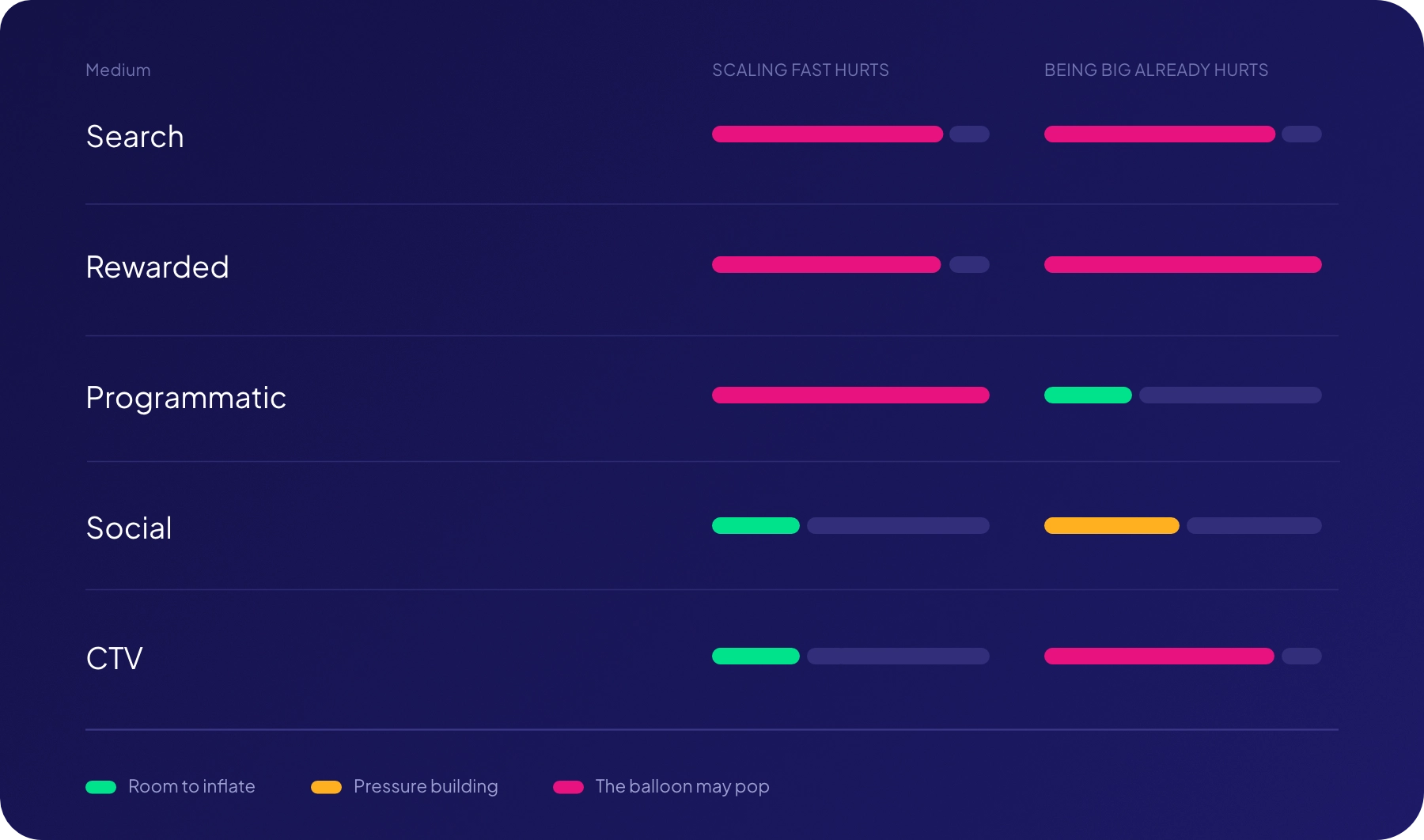
Our analysis yielded some very valuable insights – confirming some hypothesis we had, but mainly unrevealing new insights never seen before.
Search is a step function with a cliff. Almost every (new) Advertiser tends to start with Search.
At subscale – Search is beautiful, because you're harvesting intent that already exists. But search captures demand, it doesn't create it. Push past the ceiling with higher bids and lower-intent queries and the economics deteriorate fast. This validates what we found in our Attribution vs. Incrementality report, where search is consistently over-attributed relative to its real incremental value. Scale past that point and you're buying conversions your attribution model told you were cheap, and that were never really yours to claim.
Rewarded is cheap scale with hard limits. Early performance is seductive: low CPAs, high engagement, easy volume. Then a cliff. It's a user-pool problem. The number of people genuinely willing to watch a video for in-app currency is finite and relatively small. Your first budgets capture the motivated ones. After that you're paying premium prices for users who are less engaged, less likely to convert, more likely to churn. Your most efficient channel becomes your most expensive one to scale.
Programmatic is an ocean, but speed kills. The opposite story. Starting size barely matters, pace matters enormously. Even large-spending campaigns held reasonable marginal efficiency, as long as they grew gradually. Spike the budget overnight and you create auction pressure, flood yourself into weaker inventory, and trigger algorithmic behavior that prioritizes delivery over efficiency. Steady flow, not a firehose. As you might expect from an system priced by an Auction.
Social has the longest runway. Social is the biggest balloon in the room. Billions of users, endless inventory, and social scales smoothly for longer than any other channel before deviation climbs. But both dimensions eventually produce the same curve. Audiences saturate, frequency rises, and the algorithm digs deeper into people who were always less likely to convert. Runway is not immunity.
CTV has a low ceiling (For now...) The surprise in the dataset: you can ramp CTV budgets relatively fast without immediate blowback. But campaigns already spending heavily in CTV face a much sharper curve when they push further. Part of that is inventory fragmented across dozens of platforms with different standards. Part of it is that CTV is still building the measurement infrastructure older channels had two decades to construct. It's catching up quickly, and I'd expect this analysis to look meaningfully different a year from now.
Attribution doesn't measure value. It assigns credit. And average CPA is a lagging indicator that hides the fact the balloon is about to burst.
So before you approve the next increase, ask better questions. How close are you to the ceiling? When you increase the overall spend, are you seeing an overall increase? And if not – if the average cost per conversion was X before scaling – how many incremental conversions did you gain by increasing spend vs. your baseline ? Are you still profitable at your marginal CPA results or are you burning into your own profits ?
Marginal CPA = Incremental Spend / (Incremental Conversions - Baseline Conversions)
If you want to learn even more about this topic, and read the analysis we published – download the report from here:

Scaling isn't a budget decision. It's a pressure decision. Get it wrong and you're not scaling at all, you're just wasting budget faster.
 iOS
iOS Android
 Web
Web TV
TV Influencer Marketing
 Out of Home
 In game
 Podcast
 About Us
 Contact