
Platform
 Overview
 Integrations
Use Cases
Many Possibilities. One Platform.
 Marketing Changes
 Cross - Platform
 Everything
 Budget Allocation
AI and Automation
The Always-on Incrementality Platform
 Explorer
 Analyst
 Geolift
 Actionable Insights
 Media Mix Modeling
Solutions
Teams
Built for your whole team.
 Growth Marketers
 Marketing Analysts
 Data Analysts
Industries
Trusted by all verticals.
 Gaming & Entertainment
 Fintech
 Travel & mobility
 Lifestyle
 eCommerce & Retail
 Healthcare & Clinical Services
 Agencies
Mediums
Measure any type of ad spend
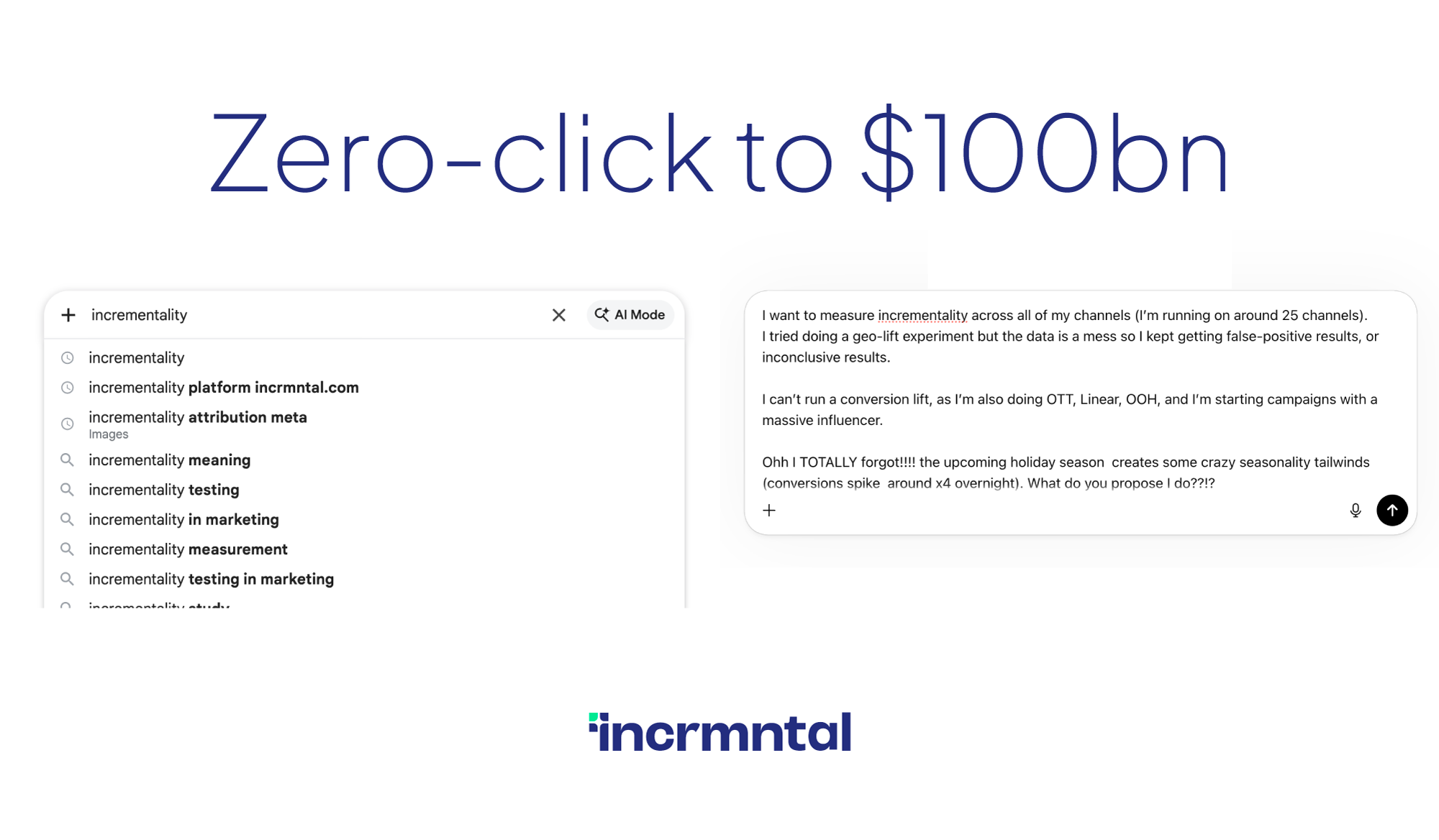
There's a moment every few years in adtech where it feels that the industry (collectively) realizes it's been using a hammer to install a screw.
It happened with mobile: we took desktop banner ads, shrunk them to 320x50 pixels, and called it mobile advertising.
It happened with CTV: we took pre-roll video, stuffed it into smart TV apps, and called it connected TV advertising.
And now it's about to happen. Faster, and larger, than most people want to admit it.
The new big medium in Advertising – LLMs. Or specifically: OpenAI/ChatGPT.
When OpenAI recently projected it could generate $102 billion in advertising revenue by 2030. The market response was, and I write this as diplomatically as I possibly can: Skeptic. Some people, completely dismissed it as “founder hype”. Others called it delusional.
I'm in the third camp. I don’t just buy into it - I think that LLM “Search Engine” Advertising (or whatever the industry ends up with as the term) will be the fastest new media to explode into existence. I've been thinking about this for a while.
Back in January 2025, I wrote about the LLM advertising opportunity , running a back of the envelope estimation, and realized OpenAI could become a serious advertising business. At the time, OpenAI's ARPU was sitting at roughly $0.67, embarrassingly low compared to Meta's $3.38 or Google's $5.12. My argument was simple: if OpenAI introduced an ad-supported tier and even partially closed that ARPU gap, the revenue upside was enormous. I estimated $26 billion in annual advertising revenue as a conservative floor.
OpenAI just told the market the ceiling might be four times that.
Here's the thing: the $100 billion number isn't crazy if you understand what OpenAI actually has.
And no – it’s not the 900 million monthly active users, and it’s not the freemium product. What they have are full conversations – not anecdotal search!
For 25 years, Google owned something priceless: the moment of explicit intent. You type a query, you declare what you want, Google serves an ad. It's clean, it's scalable, and it made Google one of the most profitable companies in history.
But here's the structural limitation nobody talks about enough: a search query is a snapshot. Three to seven words, on average. A moment of intent, stripped of all context.
Imagine a search term: "Running shoes knee pain"
It tells you something. But it doesn't tell you whether this person is a casual jogger or training for an ultramarathon. It doesn't tell you their budget, their brand loyalty, their geography beyond an IP address, whether they've already tried three other pairs, or whether they're actually looking for a physio rather than new shoes.
Google has to make a probabilistic bet about all of that based on four words and a cookie.
And because of that limitation, the number of advertisers who can relevantly bid on any given query is narrow. Running shoes. Maybe physio clinics. Maybe a misspell of a running show named: “pain”. That's roughly the universe of advertisers that would target this keyword.
You can only monetize (well) what you can infer, and a search query gives you very little to infer from.
This is Google's moat, but it's also Google's ceiling. The ad unit is constrained by the intent signal. And the intent signal is a fragment.
Our own marketing science research shows that Search yields incredible results up to a certain scale. But from a certain spend level upwards – every additional dollar spent leads to negative returns.

Now here's a scenario. Someone opens ChatGPT and types:
"I've been getting knee pain after my morning runs. It started about three weeks ago, mostly on the outside of my knee. I'm training for a half marathon in two months. What should I change?"
This isn't a search query. This is a window into a person's life.
Think about how many advertisers could relevantly reach this person from a single conversational prompt - and do so with genuine contextual relevance:
That's eight distinct advertiser categories from a single prompt. A search engine would have caught maybe two of them - if you were lucky with the query phrasing. Imagine how much could OpenAI achieve with its own audience extension network (betting everything that they would have one within a year).
This is the structural difference between search intent and conversational intent.
Search captures what you're looking for. Conversation reveals who you are.
What you're going through, and what you might need next - including things you didn't know you needed.
Google took roughly a decade to build its advertising business into a dominant revenue engine after launching AdWords in 2000. It took 18 years from $1 to $100bn in ad revenues. OpenAI’s forecast estimates it’ll take them 5 years. That’s because the conditions are categorically different.
OpenAI is entering a more mature market. One where Advertisers already have big digital budgets, already understand performance marketing, and are actively looking for new channels as traditional platforms get more competitive (and more expensive). The category knowledge exists. The budgets exist. The appetite exists.
What OpenAI has to do is show Advertisers that conversational data is a better signal than keyword intent. The “running knee pain” example shows that a prompt is more commercially useful than a keyword. Richer context. Wider advertiser relevance. Higher personalization potential.
The velocity of OpenAI's ad revenue ramp could be meaningfully faster than Google's was - not because OpenAI is a better company, but because they're entering a market that's already been educated by 25 years of Google.
Here's where I need to be honest about the challenge, because the opportunity doesn't come without a serious complication.
Search advertising was built entirely around explicit intent. The user told you what they wanted. The measurement was relatively straightforward - impressions, clicks, conversions, attribution.
LLM advertising operates on inferred intent. The platform reads a conversation, makes a probabilistic judgment about commercial relevance, and serves something it believes will land. That's a completely different problem. And the measurement frameworks, attribution models, and success metrics the industry spent 20 years refining were all calibrated for explicit intent. For a specific click. They don't translate cleanly to a zero-click world.
In a ChatGPT conversation, what's the equivalent of a click? If a brand is recommended in an AI-generated response, is that an impression? If the user follows up with a question about that brand, is that engagement? If they purchase three days later through a completely different channel - how does the conversation get credited?
Nobody has clean answers yet. And that measurement gap is where a lot of the early ad spend in this channel is going to get wasted by Advertisers who assume the old playbook still applies.
Legacy measurement won’t work here. The tools of the past won’t measure the inventory of the future.

Here's the irony. LLM advertising, in some ways, is more measurable than search - not less. Because you can't track a user through a ChatGPT conversation with a pixel or a UTM parameter, Advertisers are forced - finally - to measure actual causal business outcomes rather than proxy metrics.
Did revenue go up? Did new customer acquisition increase? Did the cohort of users exposed to LLM ads convert at a higher rate than those who weren't?
These are incrementality questions. Measuring the true causal lift of an advertising investment - rather than the correlational attribution a tracking pixel gives you - is exactly the right framework for this medium. It's the only way to answer "did this actually work?" when the click-through path doesn't exist.
The brands that win in LLM advertising won't be the ones with the biggest budgets. They'll be the ones who understand quickly that incrementality is the answer.
INCRMNTAL is an always-on incrementality measurement platform built for Advertisers who want to understand true causal impact (not just correlation). If you're exploring how to measure LLM advertising effectively, we'd love to talk.
 iOS
iOS Android
 Web
Web TV
TV Influencer Marketing
 Out of Home
 In game
 Podcast
 About Us
 Contact