
Platform
 Overview
 Integrations
Use Cases
Many Possibilities. One Platform.
 Marketing Changes
 Cross - Platform
 Everything
 Budget Allocation
AI and Automation
The Always-on Incrementality Platform
 Explorer
 Analyst
 Geolift
 Actionable Insights
 Media Mix Modeling
Solutions
Teams
Built for your whole team.
 Growth Marketers
 Marketing Analysts
 Data Analysts
Industries
Trusted by all verticals.
 Gaming & Entertainment
 Fintech
 Travel & mobility
 Lifestyle
 eCommerce & Retail
 Healthcare & Clinical Services
 Agencies
Mediums
Measure any type of ad spend

Marketing measurement frameworks are the strategic approaches and methodologies used to understand the true impact of marketing on business outcomes. For decades, marketing measurement felt simple: the last channel a customer touched got all the credit. Last-touch was broken way before privacy killed it. It was fundamentally broken from its inception.
These frameworks go beyond simple tools. They represent a philosophy for how a business quantifies value, connecting ad spend not just to clicks, but to actual, incremental growth. In a world of signal loss and walled gardens, having a coherent marketing measurement framework is no longer a luxury – but it is essential component for survival and growth.
Moving from a correlation based framework to a causal measurement framework isn't just an analytics upgrade, but it’s a strategic business decision. The right framework provides the clarity needed to navigate an increasingly complex media landscape, while empowering teams to:
Common Marketing Measurement Methodologies
Understanding the different approaches to measurement is the first step toward choosing the right one for your company. Each has its own strengths and its own blind spots.
1. Multi-Touch Attribution (MTA)
MTA models attempt to distribute credit for a conversion across multiple marketing touchpoints. They represented an improvement over last-click but are still fundamentally based on correlation. They show you the path a user took but can't prove whether that path caused the conversion. MTA only works for clients who are running digital media exclusively.
Common Models: Linear, Time-Decay
2. Traditional Media Mix Modeling (MMM)
Traditional MMM uses statistical regression on aggregated, historical data to estimate the impact of marketing channels (including offline like OOH and TV) on a KPI like sales. While powerful for top-down planning, these models are often slow to update, lack granularity, and struggle to separate correlation from causation.
Providers: Nielsen, Analytic Partners, and dozens of consultancies.
3. Causal AI & Incrementality Measurement
If Geolift experiments were the gold standard – Causal AI is the diamond standard for modern measurement. Causal AI based Incrementality measurement approach uses micro-experiments to determine what *actually changed* because a marketing activity ran. It isolates the causal impact of your changes by using past changes to calibrate the modeling answering the most important question: what would have happened if we didn’t do anything?
Platforms: INCRMNTAL, and first-party lift tools from platforms like Meta and Google.
4. Mobile Attribution (MMPs)
Mobile Measurement Partners were built to track installs for mobile app campaigns, measuring metrics like CPI and post-install events. Their reliance on device IDs has been severely challenged by privacy frameworks like Apple's ATT, forcing a pivot toward methods such as “fingerprinting”.
Examples: AppsFlyer, Adjust, Singular.
5. Survey-Based & Brand Lift Studies
These methods measure the impact of campaigns on upper-funnel metrics like brand awareness, perception, and purchase intent by surveying audiences. They are crucial for understanding brand health.
Examples: Kantar, Ipsos, Attest, Fairing
When evaluating a new measurement solution, look beyond the dashboard. Focus on the core capabilities that deliver clarity and drive action.
Questions for Your Next Measurement Partner
Choosing a partner is as important as choosing the technology. Ask the hard questions upfront to ensure you’re investing in truth, not just a prettier dashboard.
A tool is only as good as the processes around it. To build a successful measurement practice, there are a few principles we recommend adhering to.
Start with a Causal Hypothesis: Frame your measurement questions around causality (e.g., "What is the incremental lift from our new CTV campaign?").
Measure What Matters: Focus on core business KPIs, the ones you base on your decisions on. Revenues, LTV, CAC. Ignore vanity metrics like CTR, or Impressions.
Embrace a Skeptical Culture: Use measurement to foster a culture of challenging results and test new hypothesis.
Ensure Cross-Functional Alignment: Eliminate channel goals, or the separation between “brand” and “performance”. Marketing is a single, yet complex, machine
Prioritize Action Over Analysis: The goal of marketing measurement is not a nice report or a dashboard. The goal should be making smarter decisions.
Most modern measurement solutions still fall into one of two traps: they are either confidently wrong or hopelessly siloed.
Correlational models like traditional MMM or attribution platforms show you what’s related, but they can’t prove what caused growth, leading you to invest in channels that are good at being present, not effective.
Siloed point solution tools like Mobile measurement platforms, or podcast measurement platforms, can’t provide a unified view of performance, making true cross-channel measurement impossible while fueling internal battles for credit.
INCRMNTAL was built to replace guesswork with clarity. Our incrementality platform is designed around one simple, powerful question: what moved the business?
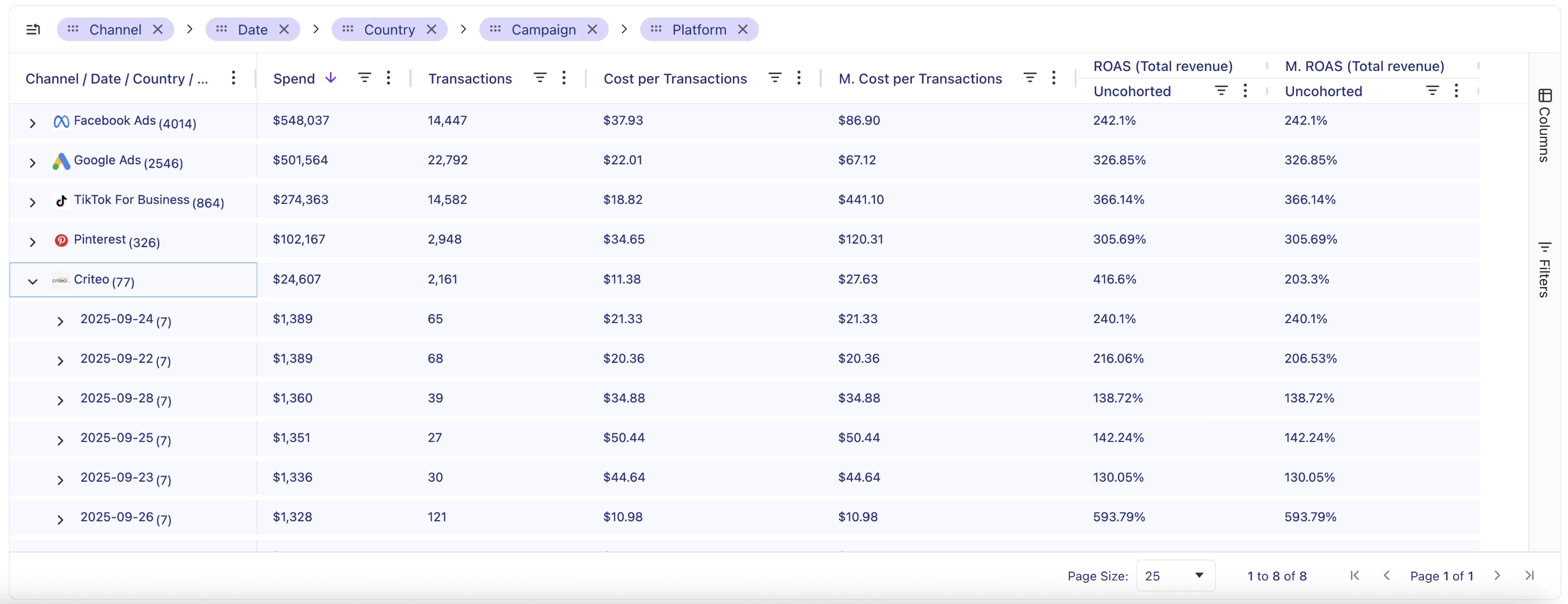
Why Incrmntal Provides True Clarity:
Incrementality at the Core: We don't just offer incrementality as a feature; it's our foundation. Our platform uses causal AI to run always-on incrementality insights, proving the true, causal impact of every channel and campaign without relying on user level data.
A Unified Causal View: We measure your full omnichannel media mix. Digital, offline, CTV, OOH, and more… This allows you to see the incremental contribution of each channel and how they work together.
For marketers seeking to move beyond correlational data, an incrementality platform like Incrmntal offers a powerful solution. By using causal AI to run always-on incrementality measurement, it provides clear answers on the true incremental contribution of each marketing channel, from CTV and OOH to mobile app campaigns. This approach to marketing attribution and media mix modeling (MMM) is designed for a privacy-first world, helping teams understand real business impact without relying on user-level tracking.
INCRMNTAL Explorer: Our granular always on incrementality insights tool lets you see the results for each of your KPI, down to a granular level.
Privacy-First and No Heavy Lifting: Our platform is built for the future, using aggregated data with no reliance on user-level tracking. We require zero SDK integration, offering the fastest and lightest onboarding in the industry.
What is the main flaw with last-touch attribution?
Last-touch attribution gives 100% of the credit for a conversion to the final marketing touchpoint. Its main flaw is that it ignores the influence of all preceding channels that built awareness and consideration, and it incorrectly assumes that the last touch *caused* the conversion.
How does incrementality measurement differ from A/B testing?
A/B testing typically compares variations within a single channel (e.g., two different ad creatives). Incrementality measurement is broader; it measures the causal lift that happened (or didn’t happen) due to marketing activities.
Is Media Mix Modeling still relevant in 2026?
Yes, but it has evolved. Traditional MMM is being replaced by Bayesian MMM, which calibrates statistical models with the ground truth from incrementality platforms or experiments.
Can you measure channels like OOH or CTV with incrementality?
Absolutely. Platforms like INCRMNTAL are perfectly suited for measuring broad-reach channels. An incrementality platform can measure the lift in sales or other KPIs in the market, thus determining the causal impact of OOH, CTV, radio, influencers, or linear TV campaigns.
How do I start with incrementality testing?
Starting is easier than ever with an always-on incrementality platform. The first step is to identify a clear hypothesis. A platform like INCRMNTAL can help you get started with minimal technical work, and begin delivering insights within days.
…In Closing…
The era of measuring clicks, tracking users, and relying on convenient but incorrect attribution models is over. Thriving in the modern marketing landscape requires a fundamental shift in mindset-from correlation to causation, from assigning credit to measuring true, incremental impact.
Adopting a robust measurement framework is the foundation of that shift.
If you're ready to stop guessing and start knowing the real value of your marketing spend, it's time to explore an incrementality platform. See how INCRMNTAL can bring clarity to your marketing and turn your team into a confident, proven growth engine.
 iOS
iOS Android
 Web
Web TV
TV Influencer Marketing
 Out of Home
 In game
 Podcast
 About Us
 Contact