
Platform
 Overview
 Integrations
Use Cases
Many Possibilities. One Platform.
 Marketing Changes
 Cross - Platform
 Everything
 Budget Allocation
AI and Automation
The Always-on Incrementality Platform
 Explorer
 Analyst
 Geolift
 Actionable Insights
 Media Mix Modeling
Solutions
Teams
Built for your whole team.
 Growth Marketers
 Marketing Analysts
 Data Analysts
Industries
Trusted by all verticals.
 Gaming & Entertainment
 Fintech
 Travel & mobility
 Lifestyle
 eCommerce & Retail
 Healthcare & Clinical Services
 Agencies
Mediums
Measure any type of ad spend

(This article is a deep dive of one of our 2026 predictions)
If 2025 was the year everyone talked about incrementality, 2026 will be the year everyone does it.
During November 2025, one of the largest mobile attribution companies launched an incrementality product. Their offering relies on experiments, but is a mobile only feature.
Now let’s imagine a scenario – this company’s platform may show a marketer that channel X generated 100,000 conversions, charging them around $1,000 for their attribution service. Their incrementality product may show that channel X generated 0 incremental conversions, charging them another $1,000 for their incrementality measurement services.
Assuming their incrementality measurement is correct – the marketer would have paid $2,000 for 0 conversions, to the very company that is supposed to be measuring.
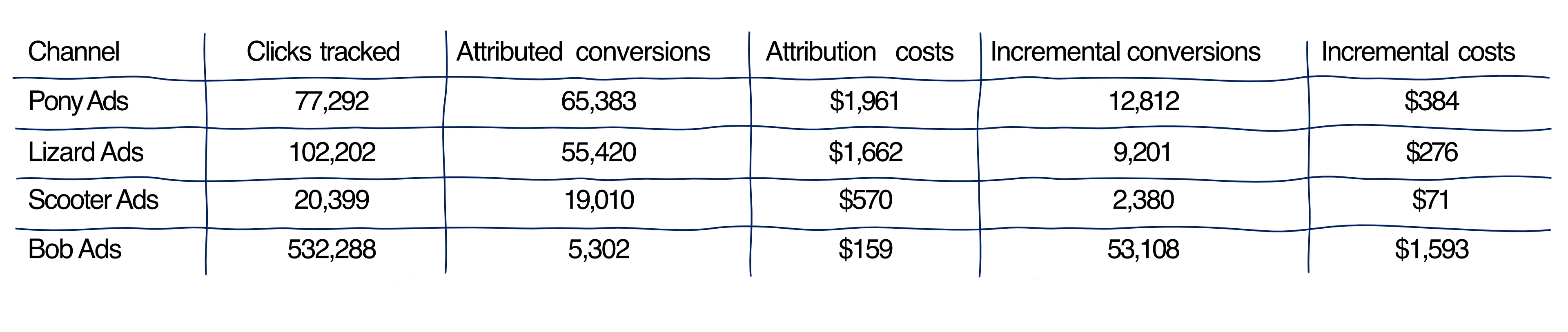
MMPs going towards incrementality does not only reaffirm the INCRMNTAL mission – it confirms that even the actual attribution companies are (finally) willing to admit that attribution as a means of measurement has been providing poor insights years.
And honestly – it’s about time.
We’re entering a world where a company not measuring incrementality continuously should raise eyebrows in every investor and board meeting. Not because it’s trendy. Because it’s basic survival. You can’t run a modern growth engine on medieval measurement logic and expect to win.
Here’s the truth no one wants to say out loud: Once marketers experience incrementality measurement, they can’t unsee it. It’s like a light switch flips in their brain. They realize:
And after that moment, there is no going back. It’s like finding out you’ve been living in a simulation.

You don’t “recover” from that. You just become the annoying person at every meeting asking the one question that makes everyone squirm: “Cool… but was it incremental?”
By 2026, that question is going to become the default. In fact, your own predictions piece nails it: “What’s the incremental ROAS?” might replace “What’s the ROAS?” as the first question in every marketing meeting.
That’s the irreversible trend. And it’s only going to intensify.
Here’s where things get messy.
As incrementality goes mainstream, the old guard will try to retrofit it onto old measurement systems. And this is where the missteps begin.
You’re going to see:
And the biggest misstep of them all: Planned Incrementality Experiments Will Hurt Progress
Yes, experiments are tangible. Yes, they feel scientific. And yes, they often lead to the most dangerous outcome in measurement: False confidence from inconclusive results.
Why? Because marketers can’t isolate the world. Experiments assume you can run a clean test:
That’s adorable.
In reality, tests often produce results that are just ambiguous enough for people to interpret however they want. If someone wants to keep spending, they’ll interpret the test as “promising". If finance wants cuts, they’ll interpret the test as “inconclusive".
So instead of progress, you get politics. That’s why we call out planned experiments as notoriously tricky and highlights the risk of false confidence in inconclusive results.
But Incrementality IS a valid objective.
Marketing is always on. Measurement needs to be always on too. No one has the time or desire to get the results of their campaigns 4-5 weeks from now. Always on incrementality is the game-changing shift for 2026: Always-On Incrementality (AI-driven) Wins Because the World Is Chaotic
The market is not static. It’s volatile. Full of external influencers that break planned tests:
A static test is basically a screenshot.
Always-on incrementality is a live video feed.

This is where AI changes everything. The promise of incrementality has always been clear. The problem was execution. For years, marketers could only measure incrementality using controlled tests, holdouts, and expensive experiments that couldn’t scale.
AI changes the equation because it allows incrementality measurement to behave the way marketing behaves: continuously.
Reinforcement learning and continuous model calibration were the missing ingredient. Instead of treating measurement as a one-off event, AI-driven incrementality learns from market behavior over time and adjusts as conditions change. It doesn’t pretend the world is stable. It assumes the opposite.
Instead of asking: “Did this work during those 2 weeks?” Always-on measurement asks: “What is working right now, and why did that change?” That’s what marketers actually need.
Always on incrementality allows marketers to actually operationalize incrementality.
Meta already sent a signal to the market that is hard to ignore: it has begun supporting optimization around incrementality, and even experimenting with pricing models tied to incremental conversions. That is not a feature update. That is a philosophical shift.
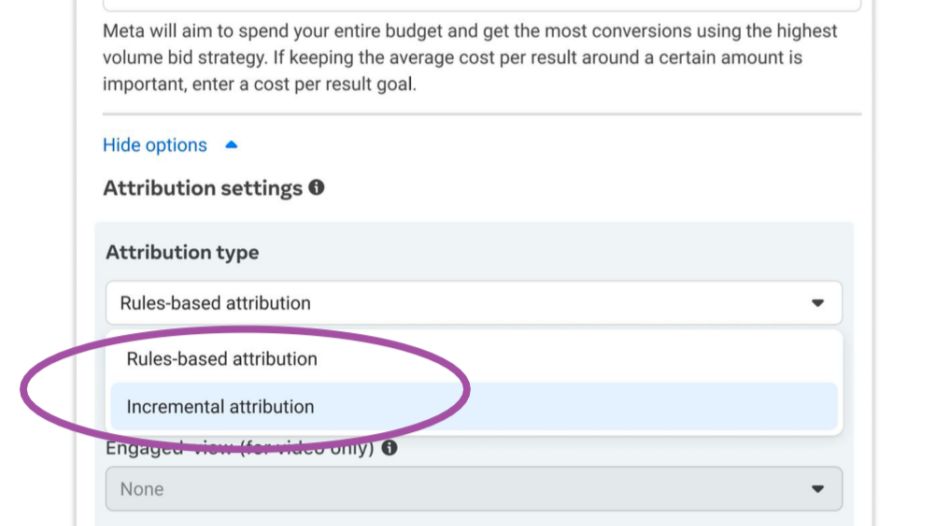
It means that the big platforms are starting to acknowledge what marketers have known for a while: attributed conversions are not the same as caused conversions. And advertisers are no longer willing to pay for demand they already had. 2026 is the year more platforms will follow.
Why? (you may ask)
Because platforms are under pressure too. Advertisers are demanding proof. CMOs are demanding business outcomes, not dashboard vanity. CFOs are demanding efficiency that holds up in board meetings. And incrementality is the only language that reliably answers:
Platforms will evolve from: optimizing for clicks and attributed conversions, to optimizing for incremental business lift.
This won’t happen everywhere overnight. But once a few major platforms adopt it seriously, everyone else will have to. Because nothing kills a channel faster than: “Cool… but it isn’t incremental.”
The rise of newer mediums is not just a media trend. It’s a measurement forcing function.
Podcasts, DOOH, CTV, and influencers are moving from “experimental” to “core budget.” And that accelerates the adoption of incrementality for a simple reason: These channels break attribution, as you can’t click your TV, and you really shouldn’t try and click a billboard.
Many don’t have clicks. Many don’t have clean user-level paths. And even when they do, attribution tends to over-credit or under-credit in ridiculous ways.

These new mediums “force” marketers toward a measurement approach that is:
In other words: always-on incrementality, attribution surveys, or both.
Because when marketers invest in channels that don’t naturally produce neat attribution trails, they have no choice but to evaluate impact the way the business experiences it: at the outcome level, not the click level.
Incrementality going mainstream is great news. For us here at INCRMNTAL, but also for you as marketers. But don’t say we didn’t warn you - the adoption curve is going to be messy. Marketers will learn quickly, but not always painlessly.
Here are the four most common missteps we expect to see as incrementality becomes a default expectation:
1. Treating incrementality as a feature, not a strategy - People run one test, feel smart, then go back to last-click.
2. Relying on planned experiments as the “truth” - The world changes mid-test, results become mush, and everyone pretends it’s clarity.
3. Measuring incrementality in silos - One channel at a time, no cross-channel interaction, no macro context.
4. Mistaking “AI” branding for AI capability - A lot of “AI incrementality” in 2026 will be retrofitted slop. It will look good in a product demo and fall apart in a messy real-world marketing environment. Call it out.
Because marketers are going to get sold a lot of magic beans in 2026.
And when those systems fail, some will wrongly conclude incrementality itself is flawed, when the real issue is that they bought a knockoff.

Here’s our forecast:
Or said differently: Incrementality is going mainstream, and the only real question is - Will you use it to get smarter, or use it to justify your existing beliefs?
2026 won’t reward measurement theater. It will reward measurement that actually reflects reality.
Incrementality is no longer the future of measurement. It’s the present.
 iOS
iOS Android
 Web
Web TV
TV Influencer Marketing
 Out of Home
 In game
 Podcast
 About Us
 Contact