
Platform
 Overview
 Integrations
Use Cases
Many Possibilities. One Platform.
 Marketing Changes
 Cross - Platform
 Everything
 Budget Allocation
AI and Automation
The Always-on Incrementality Platform
 Explorer
 Analyst
 Geolift
 Actionable Insights
 Media Mix Modeling
Solutions
Teams
Built for your whole team.
 Growth Marketers
 Marketing Analysts
 Data Analysts
Industries
Trusted by all verticals.
 Gaming & Entertainment
 Fintech
 Travel & mobility
 Lifestyle
 eCommerce & Retail
 Healthcare & Clinical Services
 Agencies
Mediums
Measure any type of ad spend
It feels like I wrote last year’s predictions only yesterday. Time flies when you’re in adtech. I do always say that years in adtech are measured in dog years.
But here I am again, marveling at how the only constant in our industry is change. If you read my 2025 piece, you know I usually get these things right – I even bragged that I nailed 7 out of 8 predictions (not too shabby for the “adtech messiah” I am in my own self-centered world). With this obnoxiously unbearable confidence in mind, I’m ready to wear my prophet gown and dive into what 2026 will be like.
If you’ve heard me speak on a podcast, or ever read something I wrote – you’ll know that some of these predictions will sound very sarcastic, some provocative, some thoughtful – and all are mostly rooted in the trends I see unfolding, given my experience and point of view.
Let’s get into it.
Connected TV advertising has been going through a big boom. And with this boom, comes a flood of fake CTV inventory that would make mobile ad fraudsters blush.
Fraud in adtech is an unfortunate integral part. When we buy 1000 impressions, we know that approximately 95% of those would be “ignored”. We accept this. This doesn’t fly in any good or service. Imagine buying a TV and be told that only 5% of the screen will work.
When it comes to CTV – the growth created opportunity for fraudsters, as the question starts with: “What IS CTV?” is Netflix on your phone considered CTV ? what about Disney+ on your laptop? What if you’re casting TikTok to a TV screen – does it become a CTV channel? CTV brought opportunity to fraudsters the moment it was not strictly defined.
In 2026, I predict a major crackdown on CTV supply chain shenanigans. Why? Advertisers are waking up to the fact that not every “CTV impression” is as premium as it sounds.
In one eye-opening test, the CTV startup Vibe found 500 bid requests for a single ad slot that should have generated maybe three. This insane duplication was thanks to layers of resellers all “representing” the same inventory.
It gets worse: some Advertisers believed they were getting ESPN CTV inventory CTV for $3 CPM only to discover it was closer to ESPAM (PS: if you think you’re buying ESPN for $3, you’re buying fraud). No wonder why some CTV platforms like Vibe are starting to cut CTV resellers in favor of direct supply.
“Fake CTV” will become a new common term, and the industry will double down on transparency. The irony, of course, is that TV finally became digital…and promptly inherited all the ad fraud issues of digital.
We expect CTV fraud to get worse before it gets better. This is awesome for us, as an incrementality platform measuring the incremental value for any channel, including CTV channels – as you guessed it – Fraud does not generate any incrementality.
Buying CTV direct from the source is also a safeguard to fraud. This is one of the reasons why we are proud to be partners with platforms like Roku which ensure that Advertisers get actual CTV inventory.
2026 will be the year Digital Out-of-Home (DOOH) advertising gets a performance marketing glow-up. Yes, I’m talking about those digital billboards and screens in the wild finally proving they can drive value, not just a CMO ego-boost.
Historically, OOH was a pure branding play. You’d put up a sign or a billboard up and hope people see it. But now, thanks to AI-driven measurement tools (ahem, including yours truly at INCRMNTAL) DOOH campaigns becoming measurable.
Measurement has been a pillar in every medium growth. If you can’t measure results – a medium never crosses the chasm between just being a novel medium vs. becoming mainstream.
With measurability no longer a hurdle, I predict performance DOOH budgets will rise in 2026. Advertisers will start expecting concrete ROI from their OOH spend (as they should!).
If 2025 was the year everyone talked about incrementality, 2026 will be the year everyone does it. A company not measuring incrementality continuously should be seriously questioned by their investors and board. We have seen many cases where conflicting incentives played a very unhealthy parts in why a company chose not to measure incrementality, but we expect such cases to become only the fringe.
Incrementality measurement will go fully mainstream. Every CMO and their dog will insist on figuring out which campaigns actually drive new revenue versus what just cannibalizes organic sales.
I predict in 2026 we’ll see a bit of an incrementality culture clash: the old guard trying to bolt incrementality onto last-click attribution systems versus the new guard using AI-driven, cross-channel models that continuously learn. We’re already seeing a rush of companies jumping on this train. Attribution dinosaurs scrambling to add incrementality products to their cloud suites, touting “holistic” while considering only mobile results (As if there aren’t dozens of factors influencing results outside of mobile).
Some are pitching “controlled experiments” and causal tests to big brands. As if marketing happens in a vacuum. Newsflash: it doesn’t.
Planned experiments are notoriously tricky: you’re supposed to avoid any other changes during the test, and hope no external factors mess with your results… which is nearly impossible. The consequence is potentially dire - false confidence in inconclusive results.

So while incrementality becomes ubiquitous, expect many advertisers to struggle with implementing incrementality based decisions. Smarter marketers realize true incrementality measurement needs to be always-on, calibrated by AI to account for all the moving parts (yours truly at INCRMNTAL has been saying this all along – measurement is complex, folks!).
And yes, more vendors will continue to pop up claiming they do incrementality. (Imitation is the sincerest form of flattery, I suppose). Ultimately, the winners will be those who embrace incrementality in an orchestrated, holistic way – not as a silo or a one-off experiment, but as a fundamental KPI across all campaigns.
By the end of the year, “What’s the incremental ROAS?” might just replace “What’s the ROAS?” as the first question in every marketing meeting. You heard it here first.
(And if one of my competitors is reading this: hi, welcome to the party! Just remember, measuring incremental impact across every channel and factor is hard – we built an AI to do it for a reason. Good luck!)
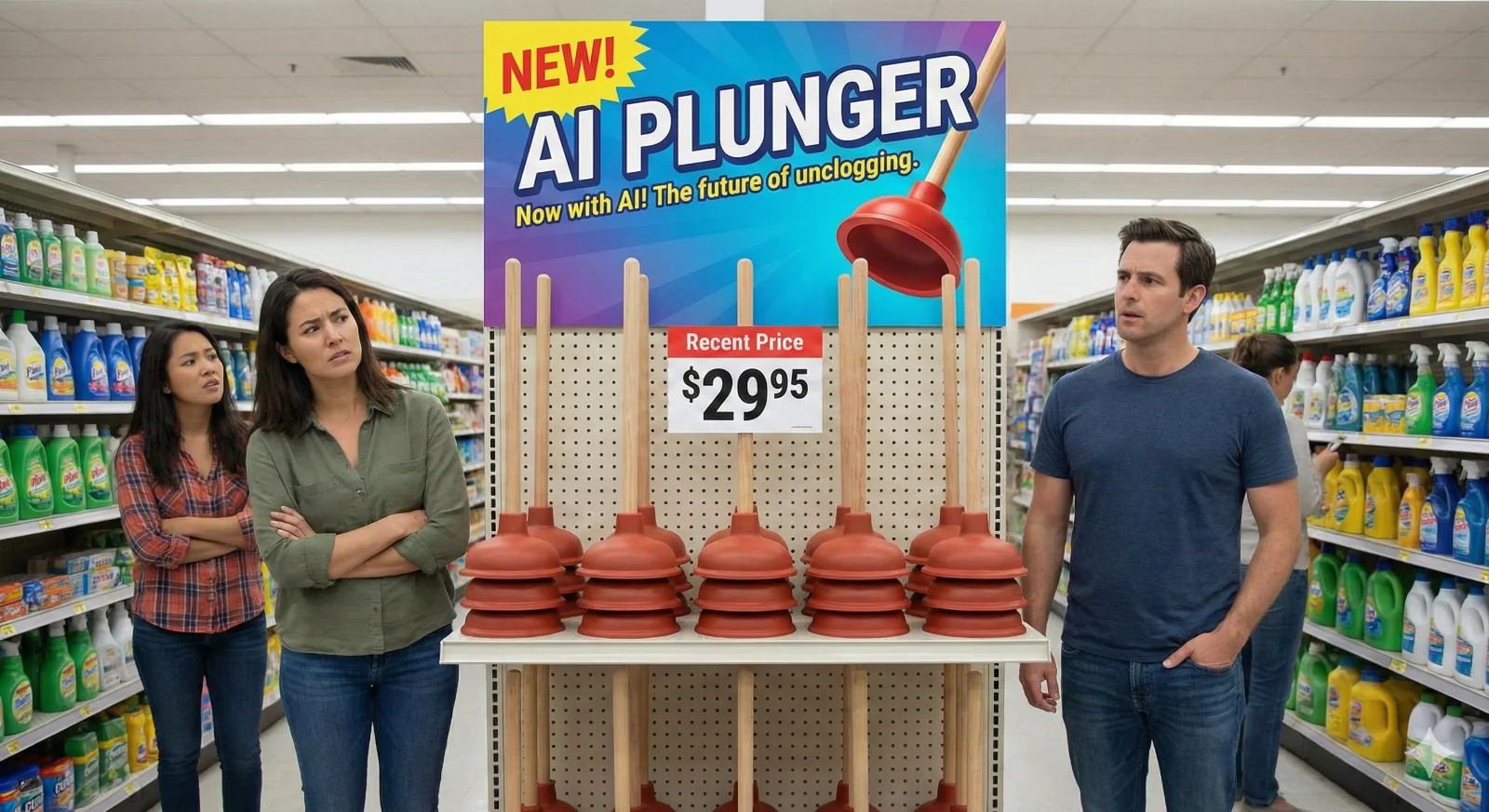
Remember when “mobile-first” was the hot buzzword? Well, in 2026 “AI-first” will be the new buzzword. We’re officially at peak AI hype, and every tech vendor, ad network, and maybe even your plumber will slap “AI” on their slogan.
Get ready for an ocean of AI-powered ad networks, AI-driven DSPs, AI-infused SSPs, AI-based SDKs…you name it. If “it” exists, someone will claim theirs is the “AI-version” of “it”. Most of it will be pure (or diluted) snake oil. Retrofitted tech with a ChatGPT API rebranded as a revolution. It’s not even AI Slop. It’s just Slop.
But beyond the AI-BS-Machine – AI will actually have significant impact, specifically, innovation. We’ll see AI personalization engines, AI bid optimizers, AI creative generators – many of which are genuinely useful, powered by the leaps in AI models we saw in since 2022 to date.
Real innovation is happening: AI copilots truly are changing how we work (media buying automation, creative suggestions, etc.), and some ad platforms leveraging AI are delivering incredible efficiencies. The key will be outcomes, not features. Slapping AI in the name isn’t enough. 2026 will force the “AI-everything” companies to prove their value or fade.
We at INCRMNTAL, welcome judgement day. 🤖
Let’s talk about podcast advertising – the sleeping giant of media that’s about to have a big wake-up party in 2026. For years, podcasts were seen as that nice little experimental channel – good for branding, hard to measure, maybe some DR here and there. No longer. We have data now showing that podcast ads drive serious results and often deliver higher incrementality than people expect. Listeners trust their favorite hosts, and when a host says “INCRMNTAL is AWESOME!” listeners act.
In 2026, I predict podcast advertising will hit a new level of growth. This isn’t just gut feel; it’s grounded in the channel diversification data we’ve seen. Our analysis of $3B in ad spend found that channels like podcasts were among the fastest-growing and most efficient for many brands. From fintech to product to consumer apps, many will realize podcasts are an under-leveraged goldmine for user acquisition.
There’s a reason for the lag between time spent and ad spend in podcast, and that’s measurement. Measuring podcasts is tricky. But as incrementality measurement going mainstream (see above), the hurdle in podcast measurement will lower. Marketers will be more comfortable allocating budget to a channel if they can measure the incremental contribution, and that’s exactly how you should evaluate podcasts – by incremental contribution, not by last-click (because, well, there is no click).
So if you haven’t tried podcast ads yet, 2026 is your chance. Your target audience is probably driving or cooking or working out, just waiting to hear about your product from their favorite host. And when they do, don’t be surprised at the performance. As we’ve said internally: podcast advertising is a GIANT opportunity.
If you’ve been playing with ChatGPT, Gemini, Grok or any other LLM, enjoy the ad-free experience while it lasts – because ads are coming. I am certain of it that by the end of 2026, most major LLM platforms will have launched some sort of advertising, or at least an ad-supported tier.
You would think that my rational is economics – but you would be half right. It’s not (just) about generating revenues, but it’s about reducing burn, while competing to the very end!
The difference between what you get in the free vs. the paid tier is enormous. The capex costs the big LLMs need to carry is huge. But if you become a loyal customer of Gemini, because they give you access to Nano Banana, you may shift across to Grok if they give you an 8k video generator for “free”.
Right now – each LLM is fighting for that market share. Everyone wants to be the Google of LLM. INCLUDING GOOGLE!
And for this purpose alone, I believe that an ad-supported tier is a must for LLMs to be able to offer users premium features for “free” at the cost of serving them highly targeted ads.
OpenAI’s own leadership has hinted at this reality: only a small percentage of users pay for the service, and “the majority of revenue for these LLM search engines will ultimately come from advertising”.
So what will LLM ads look like? Exactly like we’re used to in search. There will be a sponsored response by whoever paid more per click, followed by an organic response. We (users) are used to this. There’s no point in reinventing the generative-ai-wheel. This is my opinion. Others believe ads will be more subtle - AI-generated product placements woven subtly into answers. Maybe visual ads in chat interfaces, or “sponsored prompts”.
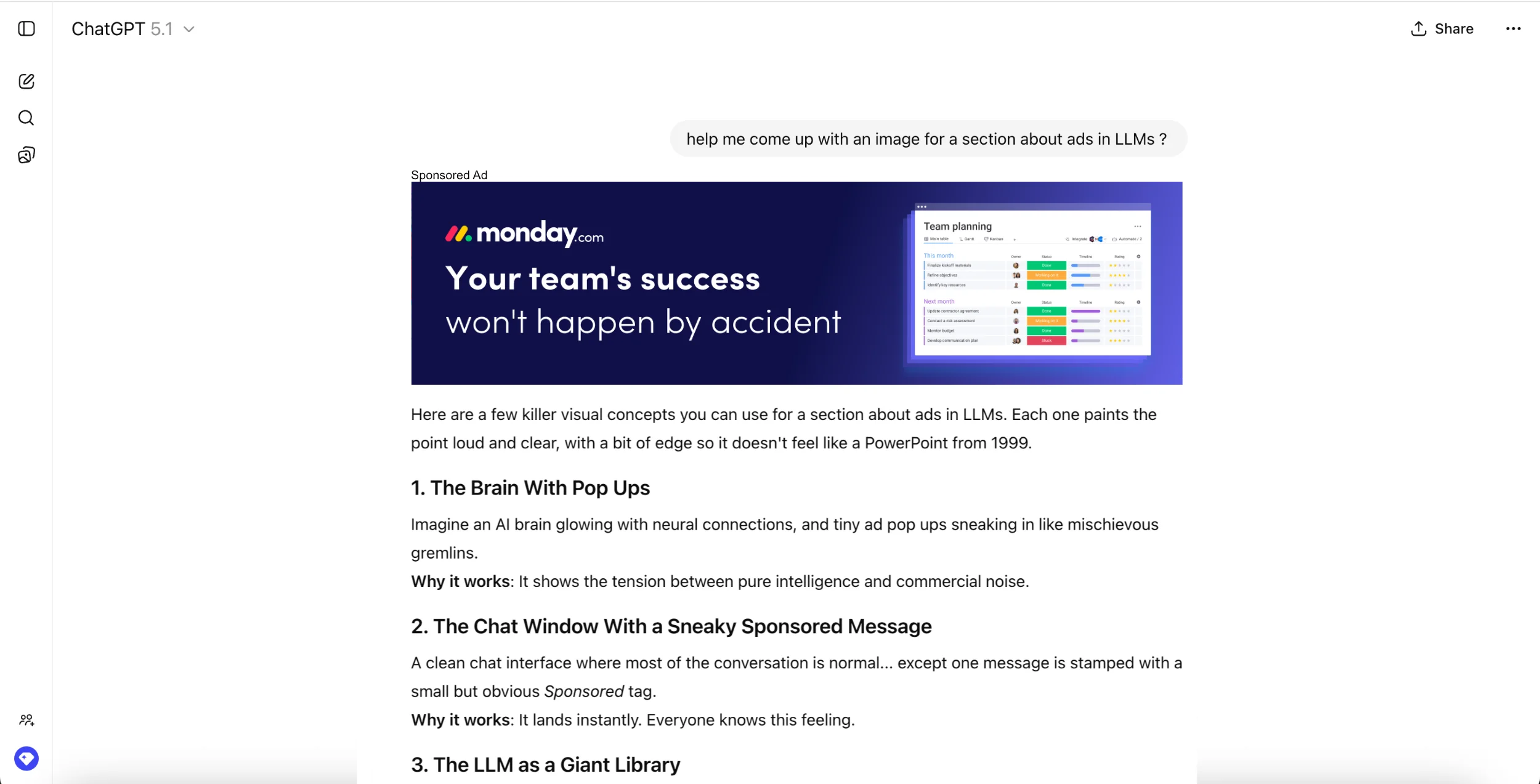
One thing’s for sure: by late 2026, “LLM Advertising” will be a hot topic at every marketing conference. We’ll have case studies about brands reaching consumers through AI assistants, debates about the ethics of AI-delivered ads. The age of LLMs being ad-free is coming to an end.
Imagine an endless feed of AI-generated content tailored perfectly to your tastes – videos, memes, stories, all created on the fly just for you. Your friends’ whatsapp messages will get a voice and a life through your personal feed. Your photo album will replay moments – even if you you never filmed those. Now imagine ads slipped into that feed. Sounds made up? Well, it’s already here in some way, and 2026 will see the rise of what I’ll call AI mega-publishers.
I’m talking about apps like OpenAI’s new Sora and Google’s Veo. These are essentially TikTok-like platforms powered entirely by AI. OpenAI’s Sora 2 app, for example, generates endless short-form videos, with a feed that looks and feels like TikTok. Google is not far behind, integrating its Veo 3 video generation into YouTube and even launching an AI-only feed. This tells me a few major players are betting on a new content paradigm: endless AI feeds that they own and operate, filled with content that doesn’t require paying a single creator.
Why does this matter? Because whoever wins at this could become the next TikTok-scale publisher and more. TikTok showed how a killer algorithm + an endless scroll of video can capture billions of hours of attention. Now imagine every video being personalized to you based on your own context and taste in real time? While it’s creepy, you’ll likely agree that users will get hooked on this.
I predict in 2026 we’ll see such apps, and the start of a massive user acquisition campaign behind one or more of these. Think nine-figure spend to grab market share, the way TikTok spent in its early days.
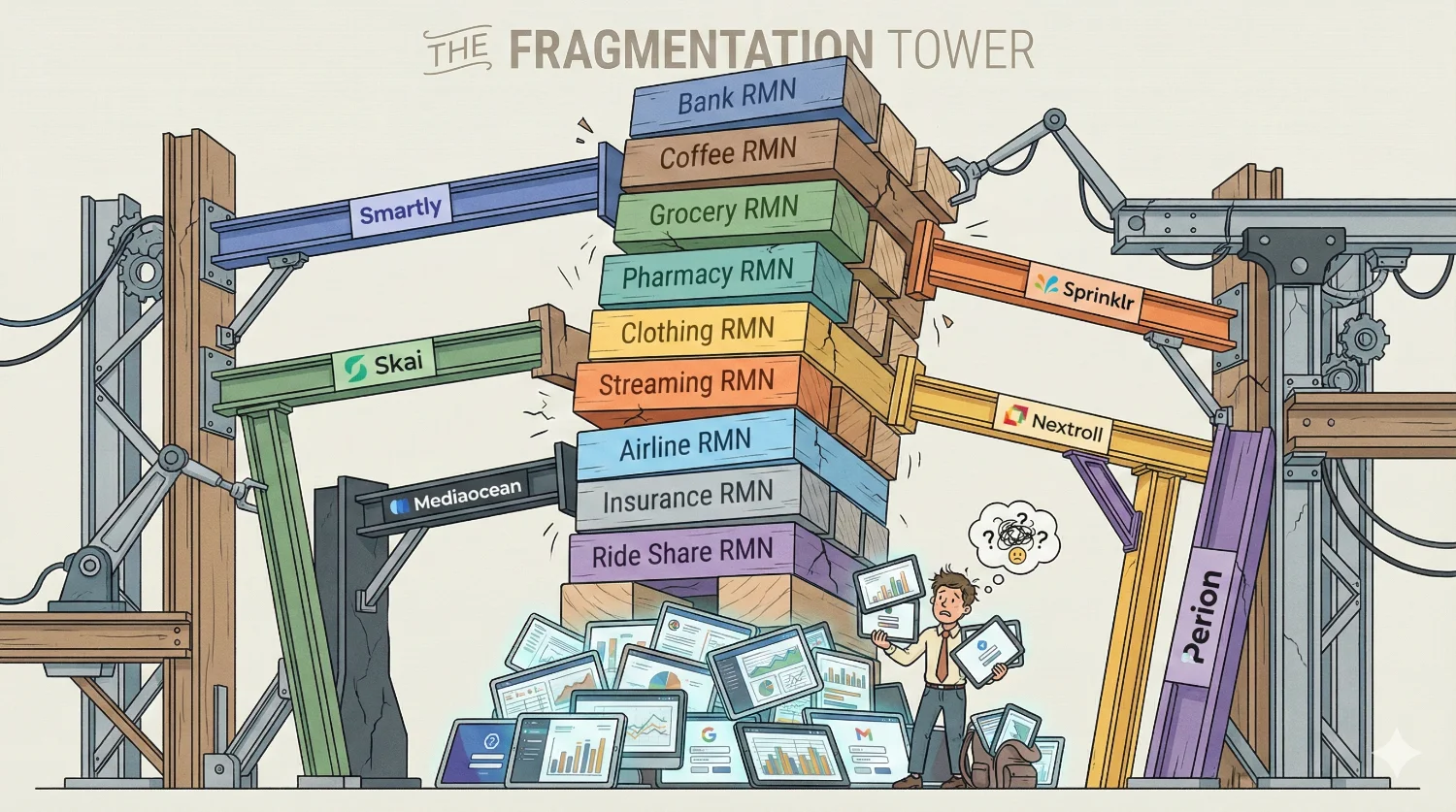
One of the brightest spots in 2026’s adtech in my opinion will be the continued rise of unique retail media networks. By now, everyone knows about UBER, Walmart, Target, and Amazon’s networks. But you haven’t seen nothing yet! I predict that everyone with first-party data will be monetizing that. I’m talking banks, insurance companies, coffee chains, the GAP, and others. Any business that has eyeballs could launch their own “ad network” and monetize that audience with ads.
Every business is looking for incremental revenue streams, especially if their core business is under margin pressure. And an ad slot here or there in a banking app or a streaming menu is pure profit at a very high margin. Ad revenue profits do often get as high as the business core revenues!
The first challenge? Fragmentation. If “everything is an ad network”, media buyers will be juggling even more platforms and log-ins. That’s where I see opportunity for the likes of Smartly.io, Skai, and other automation tools. The integration of these unique inventories into omni-channel buying automation platform that can adapt creatives, and automate the campaign management with workflows will be critical for scalability.
Retailers are already integrating DSPs to allow programmatic access to their inventory. Companies like Mediaocean, Sprinklr, Nextroll, Perion are undoubtedly eyeing this space.
The real challenge? Measurement. These new networks have unique, well-guarded inventory. A bank knows your income and spending habits, an insurer knows when you bought a house or had a baby, a grocery chain knows what you eat. Measuring who lead the user to purchase, in a world where cookies are broken will require more advertisers adopting AI attribution.
Some trends are smaller or developing on the sidelines. Here’s a rapid-fire lightning round of predictions and thoughts:
Those are my bets and bold predictions for 2026. In past years I got around 90% of it right. I learned that I’m able to make wild bets and believe in drastic change, as after over two decades in this space, I repeat the rule I learned: The only constant in adtech is change – and I, for one, am excited about the changes coming this year.
So here’s to 2026: may your CTV bids be fraud-free, your models be incrementally validated, your AI actually intelligent, and your ads seen by real humans. And if any of these prophecies don’t pan out – well, it may humble me for a change
Cheers to the new year!
Yours, Maor

Maor is the CEO & Co-Founder at INCRMNTAL. With over 20 years of experience in the adtech and marketing technology space, Maor is well known as a thought leader in the areas of marketing measurement. Previously acting as Managing Director International at inneractive (acquired by Fyber), and as CEO at Applift (acquired by MGI/Verve Group)
 iOS
iOS Android
 Web
Web TV
TV Influencer Marketing
 Out of Home
 In game
 Podcast
 About Us
 Contact