
Platform
 Overview
 Integrations
Use Cases
Many Possibilities. One Platform.
 Marketing Changes
 Cross - Platform
 Everything
 Budget Allocation
AI and Automation
The Always-on Incrementality Platform
 Explorer
 Analyst
 Geolift
 Actionable Insights
 Media Mix Modeling
Solutions
Teams
Built for your whole team.
 Growth Marketers
 Marketing Analysts
 Data Analysts
Industries
Trusted by all verticals.
 Gaming & Entertainment
 Fintech
 Travel & mobility
 Lifestyle
 eCommerce & Retail
 Healthcare & Clinical Services
 Agencies
Mediums
Measure any type of ad spend

British Economist named David Ricardo figured (and wrote) about the concept of “diminishing marginal returns” about 200 years ago in 1817. In his research, he named the law of diminishing returns which says that as you keep adding more of one input while holding others constant, each additional unit eventually produces smaller and smaller gains in output.
Or in adtech terms: Your first 100 conversions might have cost you $100, your next 100 conversions might have cost you $200, but the next 100 conversions may cost you $500. Every incremental conversion has a higher marginal cost.
When this rule is explained, Every marketer nods along in Marketing 101, agrees it makes sense, and then goes back to the office to build next quarter's budget assuming that doubling spend will roughly double results.
Why the disconnect?
Because no dashboard you use actually shows you the curve.
Your attribution platform shows you points. A CPA last month. A CPA this month. A nice line chart if you're feeling fancy. What it cannot show you is the slope - the cost of the next conversion versus the cost of the last one. And that's the only number that matters when someone asks "can we scale this?"
Diminishing returns isn't a risk. It's not a possibility. It's not something that might happen if you're unlucky with your creative refresh.
It's the floor plan of every channel you run. Every campaign. Every audience. The only question is where on the curve you currently sit, and how steep the next step up is going to be.
The first $100K works. The next $100K works a little less. The third $100K is where the budget meeting gets awkward. By the fourth, someone is asking if “tracking is broken”.
Tracking is fine. The curve is doing exactly what curves do.
The reason marketers keep getting blindsided by this isn't that we forgot the economics. It's that the entire legacy attribution stack was built to hide it.
Attribution platforms have one job: assign credit for conversions that already happened. That's it. They look backward, they divvy up the pie, they hand you a CPA, and they call it a day.
There's nothing in that workflow that asks "what would the next dollar have done?" There's nothing that compares your marginal cost to your average cost. There's nothing that tells you the slope is steepening.
Attribution shows you a flat number. Reality is a curve. Those two things will never be the same thing.
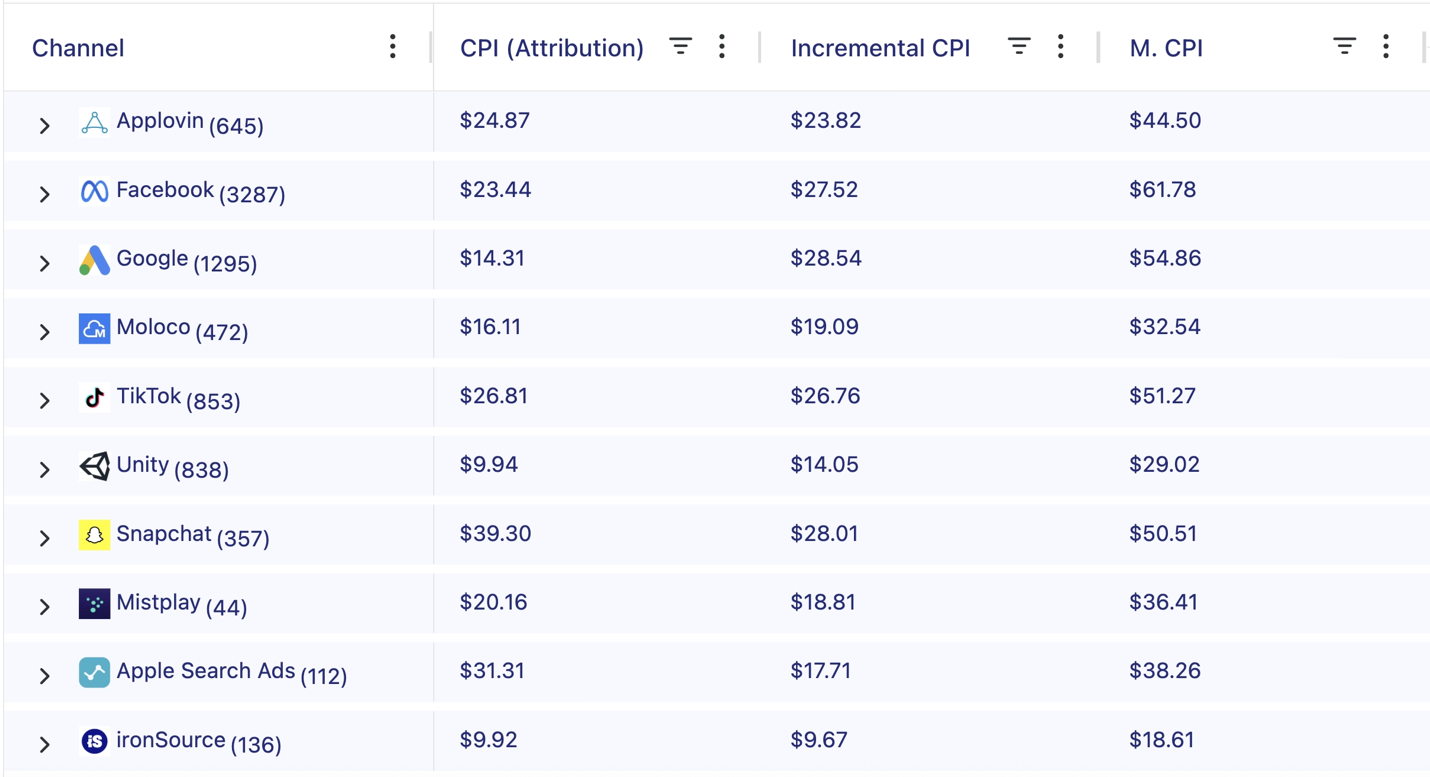
This is why advertisers keep getting surprised. The dashboard says CPA is $24.87. They double the budget. The dashboard still says CPA is $24.87, because averages are sticky and lagging. Three months later, someone digs into the data and realizes the last 20% of spend was running at $44.5 the whole time – which is why they’ve been unprofitable on 30% of the conversions. The "average" was hiding the truth..
Average CPA is the Most Dangerous Number in Your Stack
I'll go further. Average CPA isn't just incomplete. It's actively misleading you.
If your campaigns have been spending steadily for six months, your average CPA is a six-month rolling “memory” of every cheap conversion you bought back when the audience was fresh. It's an artifact of decisions you already made.
The decision in front of you - should I add another $50K next month? - has nothing to do with what the last six months results. It has everything to do with what the next $50K will cost.
Those are completely different numbers. Treating them as the same is how companies quietly become unprofitable while every dashboard still shows green.
There's a tendency in adtech to treat marginal analysis like it's some elite exercise. It isn't. It's the question every other industry asks by default.
A factory manager doesn't ask "what's the average cost of the cars we built this year?" when deciding whether to add a shift. They ask what the next car will cost. A pricing team doesn't set tomorrow's price based on last quarter's blended margin. They look at the marginal economics.
Marketing skipped that step. We built an entire measurement industry around backward-looking average metrics, then convinced ourselves this was sophisticated because the dashboards had a lot of filters.
Marginal CPA is not advanced. It's the basic skill marketing has been skipping for two decades.
Before you approve next quarter's budget, you need to know three things that no attribution tool will tell you:

If you can't answer those three questions for every active channel, you don't have a budget plan. You’re throwing budgets at ad platforms, hoping results will come. That’s not a marketing strategy.
We wrote much more about this in our white paper: The Ultimate Marketing Budget Planning Handbook
Here's the thing about diminishing returns. It doesn't care whether you measure it. It happens whether you're looking or not. The only question is whether you find out from your data, or from a board meeting in Q4 where someone wants to know why CAC tripled all of a sudden.
The advertisers who scale well aren't smarter. They're not luckier. They've just stopped pretending the curve doesn't exist, and started measuring the slope instead of the average.
Two hundred years of economics agrees with them. Your dashboard is the last thing in the room still arguing.

Next month, we’re releasing The Balloon Effect - an analysis of $1B+ in ad spend across 50 U.S. advertisers, showing exactly what these curves look like in CTV, Programmatic, Search, Social, and Rewarded inventory. If this piece made you uncomfortable about your average CPA, this report will help explain the why.
INCRMNTAL measure incremental contribution and marginal returns across every KPI the advertiser wants to measure. You can see it in action by scheduling a live demo.
 iOS
iOS Android
 Web
Web TV
TV Influencer Marketing
 Out of Home
 In game
 Podcast
 About Us
 Contact