
Platform
 Overview
 Integrations
Use Cases
Many Possibilities. One Platform.
 Marketing Changes
 Cross - Platform
 Everything
 Budget Allocation
AI and Automation
The Always-on Incrementality Platform
 Explorer
 Analyst
 Geolift
 Actionable Insights
 Media Mix Modeling
Solutions
Teams
Built for your whole team.
 Growth Marketers
 Marketing Analysts
 Data Analysts
Industries
Trusted by all verticals.
 Gaming & Entertainment
 Fintech
 Travel & mobility
 Lifestyle
 eCommerce & Retail
 Healthcare & Clinical Services
 Agencies
Mediums
Measure any type of ad spend
(This article is a deeper dive from our 2026 predictions)
I’m predicting that our world will get a new type of publisher, one that will outgrow TikTok, Instagram, and potentially even YouTube. I believe that our world will go from a “for you” feed to an “exactly and exclusively for you” feed.
For the last decade, the internet has been eating the world. In 2026, it’s going to start manufacturing it. Not “content,” not “media,” not even “attention” - reality.
I believe that we’re about to enter the era of the AI-powered mega-publisher: a new category of platform that doesn’t just distribute content, but generates it on demand at internet scale. The feed won’t be curated. It won’t even be created by humans. It will be assembled in real time, tailored to each individual user’s psychology, preferences, social circle, emotional state, and personal history.
If TikTok built the most powerful recommendation engine ever deployed at consumer scale, the next wave will do something even more aggressive:
It will build a recommendation engine for content that does not exist yet.
This isn’t the next Instagram. This isn’t even the next TikTok.
This is the next publisher, except the publisher is an AI factory and the editorial team is you.
And it’s going to climb to the top of the charts faster than anyone expects.
Here’s the core prediction:
In 2026, an “AI shorts app” will launch that is exclusively generative, designed to serve an endless feed of AI-created short-form videos. It will be backed by a terrifyingly large user acquisition budget, the way TikTok was - not as a hobby, but as a conquest.
It will have the “For You” experience, but it will evolve beyond it. The pitch will be simple and addictive:
“Your feed. Your stories. Your world. Made for you.”
And it will work. Because it will feel like magic.
But the truth is: it won’t be magic. It’ll be strategy.
What’s coming is not an app that competes with TikTok using better content. It’s an app that competes using custom content per user, generated instantly and endlessly - the ultimate dopamine machine.
If you think TikTok is sticky, imagine a feed that is not based on what you “like,” but what it can infer from what you are.
If TikTok’s brilliance was personalized recommendations of content: it watches, learns, predicts, and serves content you can’t stop watching.
The AI mega-publisher will go one step further: It will generate content specifically for you, based on your own personal universe.
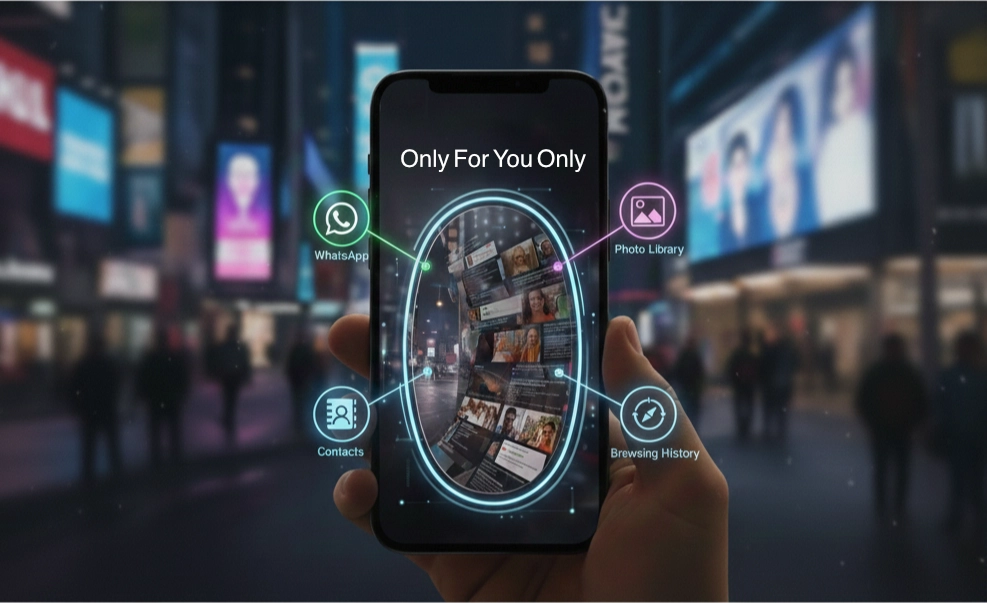
To do that, it will start by basic information about you – whatever it can get from your device, IP, time installing the app, and other meta-information, but it will get a lot “better” once it will ask for permissions that most users will absolutely grant:
• Access to your contacts
• Access to your photos
• Access to messages (IM, email)
• Access to your schedule
• Access to your precise location
• Access to the microphone
• And any other signal your devices can share
And with that, the app will build a living model of your relationships, your memories, your mood cycles, your life events, and your social graph. Then it will generate videos that feel like they’re “about you,” even when they’re not.
You’ll see:
• AI-generated “inside jokes” based on your friend group
• Short stories starring characters that resemble people you know
• Memes built from your WhatsApp message tone
• Videos narrated in the voice of someone you trust
• Fictional moments that feel like real nostalgia
• Entire mini-series written for your emotional vulnerabilities
This is not personalization in the old sense. This is personalization as identity mirroring.
And it’s going to hit so hard that it will feel like the internet learned your soul.
Once the feed is fully synthetic, the unit economics change dramatically. Traditional platforms rely on creators, incentives, content policies, moderation, partnerships, and the messy chaos of human production.
AI mega-publishers replace that with:
• algorithmic generation
• infinite inventory
• zero creator payouts
• faster iteration
• direct control over narrative
• content designed to maximize watch time
And here’s the scary part: If the content is generated, it can be optimized like ad tech. We have almost three decades of experience in this.
A/B tests, reinforcement learning, emotional hooks, micro-variations, story pacing - all tuned per user.
This is what happens when the logic of performance marketing gets applied to entertainment at the level of the human mind. The result will be the most efficient attention-extraction system ever created.
And it will print money.
Once one of these platforms wins early traction, the rest will follow, as as the barriers to entry will shrink fast:
• models will get cheaper
• generation pipelines will improve
• templates will scale
• synthetic voices will become indistinguishable
• AI agents will be able to produce entire production-quality short films
The winner won’t necessarily be the best product. It’ll be the one that can buy distribution and iterate faster. Exactly like TikTok.
The difference is: TikTok scaled distribution. This scales reality generation.
Here’s the warning embedded in this prediction, and it matters. These apps will be insanely entertaining. They will be emotionally satisfying. They will be ultra-relevant. They will feel personal. And that’s exactly why they will be dangerous.
Because human relationships are difficult. They require patience. Misunderstandings. Apologies. Compromise. Time.
AI relationships are frictionless. AI content is perfectly engineered to meet you exactly where you are. It never needs anything from you. It never disappoints you. It never says “I’m busy” or “I don’t feel like talking.”
So what happens when an app offers an experience that feels socially rich, emotionally tailored, and endlessly validating… without any social risk?
You start choosing it over real life. Not consciously. Not dramatically. Gradually.
The way we’ve already seen happen with modern feeds - except now the content will be so customized that it will feel like it was made by someone who truly gets you, and this is dangerous.
We are already living through a loneliness epidemic in the developed world. The AI mega-publishers won’t create it, but they will absolutely accelerate it.
They will make solitude more seductive.
Some people will argue we should slow AI progress until regulation catches up. Some people may protest. That’s naïve.
It’s also unrealistic in a global economy where:
• nation states view AI as strategic infrastructure
• companies compete in multi-trillion-dollar markets
• consumer demand is insatiable
• startups will ship what they can ship
• the world rewards speed and disruption
Even Stanford’s own AI experts are already framing 2026 as a year where the world is forced to confront AI’s real utility, accountability, and consequences, because the hype era is colliding with reality.
And outlets like WIRED are openly describing 2026 as a year of anxiety around AI’s societal risks and structural consequences.
So yes - regulation will try. But it will always lag.
And the biggest platforms will always be ahead of the rulebook, because they can move faster than governments, faster than courts, faster than policy, faster than consensus.
This prediction doesn’t arrive all at once. It arrives in signals. Here are the early indicators:
1. A Shorts App That Requires Personal Data Upfront - Not “allow notifications,” but “connect your world.”
2. Generative Video That Feels High Quality, Not Sloppy - The moment AI video crosses the threshold from “cool demo” to “I’d watch this for an hour.”
3. Aggressive Creator Outreach, Then Sudden Creator Irrelevance - Creators will be used for credibility early, then replaced by the machine.
4. A “For You” Page That Evolves Into “For Your Life” - Content becomes personal in ways that make users feel seen.
5. A Massive UA Spend With Instant Virality - Like TikTok’s early days, but faster because the content production bottleneck is gone.

I don’t like it, but I believe this is inevitable, and I’m certain I’ll use it. I will be very careful with setting boundaries, and educating my kids so that they don’t lose their childhood to an app. The most successful consumer product launched in the last years are the ones monetizing on humanity’s tendency to be addicted to fountains of dopamine. We’ve seen it with Facebook, with Instagram, with TikTok, and I expect we will see it in new magnitudes with a gen AI app.
This app will be seductive. A feed that understands you, a world that adapts to you, stories that feel like home.
The biggest threat isn’t that AI content will be fake. It’s that it will be better than real life in the ways that matter most. Leading to people choosing to live in the matrix.
So the real question for 2026 isn’t “will people use it?”
It’s: what happens when they don’t want to leave?

Maor is the CEO & Co-Founder at INCRMNTAL. With over 20 years of experience in the adtech and marketing technology space, Maor is well known as a thought leader in the areas of marketing measurement. Previously acting as Managing Director International at inneractive (acquired by Fyber), and as CEO at Applift (acquired by MGI/Verve Group)
 iOS
iOS Android
 Web
Web TV
TV Influencer Marketing
 Out of Home
 In game
 Podcast
 About Us
 Contact