
Platform
 Overview
 Integrations
Use Cases
Many Possibilities. One Platform.
 Marketing Changes
 Cross - Platform
 Everything
 Budget Allocation
AI and Automation
The Always-on Incrementality Platform
 Explorer
 Analyst
 Geolift
 Actionable Insights
 Media Mix Modeling
Solutions
Teams
Built for your whole team.
 Growth Marketers
 Marketing Analysts
 Data Analysts
Industries
Trusted by all verticals.
 Gaming & Entertainment
 Fintech
 Travel & mobility
 Lifestyle
 eCommerce & Retail
 Healthcare & Clinical Services
 Agencies
Mediums
Measure any type of ad spend
Sometimes we shock ourselves. On January 5th 2025, we published an article analyzing the opportunity size of ads on LLM. Back then our hypothesis was that ads on LLM are inevitable for a few main reasons:
We felt so strong about this one, that we included it as one of the top 2026 predictions and premonitions.
And look at it here – Our prediction turned into reality. Ad-free LLMs will feel like a brief moment in tech history where the user was not the product. And that moment is over.
What was framed as a 2026 prediction is now a mid-January fact.
OpenAI has publicly laid out its plan to begin testing advertising inside ChatGPT, acknowledging ads as part of its strategy to expand access to AI and make the free tier sustainable. This is coming straight from the company’s own official blog update.
But now that it is here, the real story is what it means for marketers, measurement, and the future of digital advertising.
Let’s be honest. The lazy explanation some pundits throw around is that ads exist to generate revenue. They do – and lots of it – but that’s only half the story.
The real driver behind the need of going into advertising are the brutal economics of LLM infrastructure. Training and running these models cost enormous amounts of compute and data center spend. OpenAI itself has said ads are part of how it will “expand access” to AI while protecting the user experience.
Remember, in my original piece I argued the same thing - that LLM ads are not just about revenues, but about reducing burn while competing to the very end.
Eric Seufert at MobileDevMemo nailed this from the beginning: OpenAI simply cannot monetize the vast majority of its user base through subscription alone, so it will need to monetize them another way - and ads are the obvious lever.
This is not greedy. This is math.
Everyone wants to be the Google of LLMs. Including Google. But if you think that OpenAI is the challenger and Google is the incumbent – you should really brush up on your tech history.
Google has been dominating the internet’s in terms of revenues, generating over $100bn in one quarter (Q3 2025), having captured users intent with Search, Video Search (YouTube), and chunking into the enterprise market share of the redwood based incumbent: Microsoft.
Microsoft, being the smart strategic chess player knew that rather than attempt to acquire OpenAI (which would likely get blocked by the FTC, or the DOJ, or the CMA, or the European commission…choose one) – Microsoft secured their position by investing $13bn in cash , giving them a seat at the table (literally) and the power to influence OpenAI’s roadmap and strategic decisions.
Rather than own – Microsoft is able to partner with - and gain a totally integrated experience within its products (Windows, Office). Moreover, having a seat at the table allowed Microsoft to have a say in any potential future OpenAI > Apple deals, or OpenAI > Google deals – deals that would likely require board approval due to their size and potential impact on OpenAI’s own future.
To threaten Google’s incredible positioning – Microsoft HAD to chip away into their revenues, and developing a newer search competitor with OpenAI ads was far more likely than Bing’s revenues scaling to compete with Google.
The ad-supported tier is not just about money - it’s about retention and habit formation. And yes, it’s also about MSFT vs. GOOG. Indirectly, at least.
Contrary to some wild predictions that ads will be ultra-stealthy or bizarre AI product placements, the most effective form of LLM advertising will look a lot like search ads.
Here’s the mockup from OpenAI’s blog post:
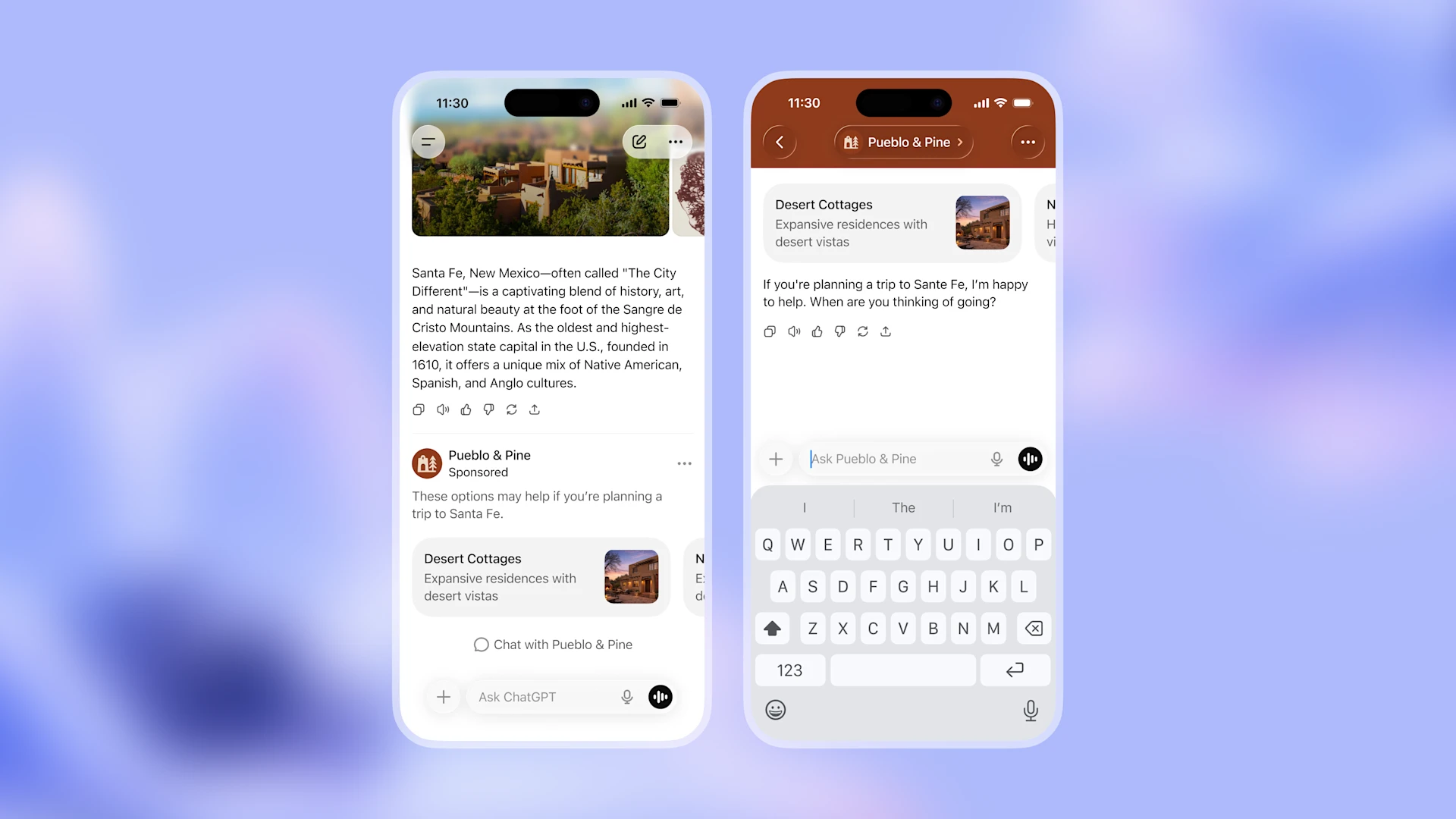
Sponsored results above or below organic responses. Clearly labeled. Contextual to user intent. That’s what works at scale, and what users are already trained to tolerate.
This echoes what industry analysts are observing as OpenAI begins testing ads in ChatGPT Free and Go tiers.
We don’t assume ads will end there. There will likely be a lot of innovation – both in ad products - sponsored prompts, integrated recommendations, and experimentations with visual placements – but the real interesting part will come over time, as OpenAI brings on an AI campaign creation, AI campaign targeting, Agentic creative generation, personalization, and Agentic optimization.
This is where things get very real for marketers.
LLM advertising breaks the traditional funnel. Organic results lead to no click, no landing page. There is just engagement and influence inside the AI interface itself. Almost like a Digital Out of Home campaign.
We’re can’t yet know how user journeys will look like in this new world or within the agentic world – but we know that the measurement tools of the past – won’t work on the advertising of the future.
INCRMNTAL’s always-on measurement doesn’t rely on clicks, impressions data, nor any user-level data. We don’t need a postback from OpenAI, or any SDKs integrated on ChatGPT or SORA. The technology we developed measures by finding the causal relationship between changes and the results generated thanks to those. This change logging is automated – even for channels that don’t yet have any reporting APIs, or change logs.
This means that INCRMNTAL will be measuring the results of OpenAI and ads on LLM starting the first dollar spent by any customer using our platform.
What we thought was a long era of ad-free AI tools was really just the beta phase of the internet’s next big channel.
Today, ads in AI assistants are not a distant threat. They are a known change happening now.
OpenAI’s announcement proves that my prediction was not a guess - it was a well-grounded interpretation of the economic and competitive forces shaping the space.
By the end of 2026 we won’t be talking about whether ads might come to LLMs.
We will be talking about how to measure their impact, optimize them responsibly, and integrate them into broader marketing strategies.
Carve outs:
I’ve been listening to a lot of podcasts recently, and the two I recommend which help me grasp the changes in our world are the following:

Maor is the CEO & Co-Founder at INCRMNTAL. With over 20 years of experience in the adtech and marketing technology space, Maor is well known as a thought leader in the areas of marketing measurement. Previously acting as Managing Director International at inneractive (acquired by Fyber), and as CEO at Applift (acquired by MGI/Verve Group)
 iOS
iOS Android
 Web
Web TV
TV Influencer Marketing
 Out of Home
 In game
 Podcast
 About Us
 Contact